Czech Central Bank Governor Rejects Early Euro Entry and Rate-Cut Pressure
Aleš Michl says persistent underlying inflation warrants tight monetary policy and argues that surrendering the koruna prematurely would remove an important economic stabilizer.
Czech National Bank Governor Aleš Michl has rejected political pressure for lower interest rates and rapid adoption of the euro, arguing that both would weaken the country’s ability to contain domestic inflation.
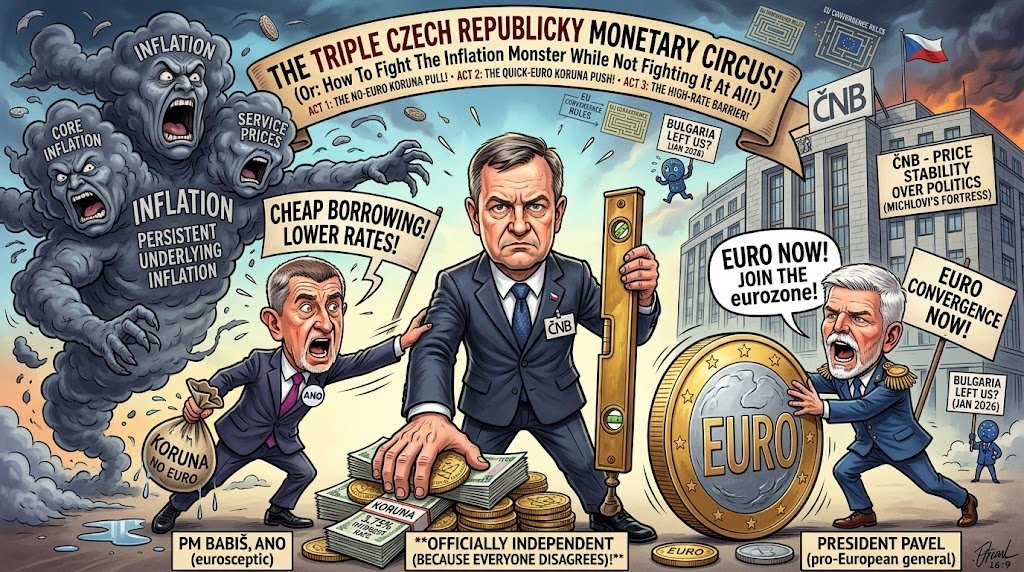
He described the competing demands from Prime Minister Andrej Babiš and President Petr Pavel as a battle of mistimed ideas from which the central bank must remain independent.
Michl’s intervention places the monetary authority between two opposing political projects.
Babiš, a eurosceptic who returned as prime minister after his ANO movement won the 2025 parliamentary election, wants borrowing costs reduced and opposes replacing the koruna.
Pavel, a pro-European former general who defeated Babiš in the 2023 presidential election, supports progress toward joining the eurozone.
The governor agrees with neither prescription at present.
He warned that lowering rates before domestic price pressures have subsided could jeopardize price stability.
Moving too quickly into the euro, he argued, would deprive the Czech Republic of its own interest-rate policy and flexible exchange rate before its economy had converged sufficiently with the currency union.
The central bank raised its benchmark two-week repo rate by a quarter of a percentage point in June, taking it to 3.75 percent.
It was the first increase in four years and contradicted Babiš’s public preference for cheaper credit.
The decision reflected concern about rapid wage growth, service prices and persistent core inflation rather than the headline consumer-price figure alone.
Annual inflation fell to 1.5 percent in June, below the bank’s two percent target, as food and fuel prices moderated.
Core inflation, which removes volatile components to expose broader price momentum, remained just below three percent and had shown no clear downward tendency.
That divergence explains why the bank does not regard one favorable headline reading as sufficient grounds for easing.
Higher interest rates restrain borrowing, consumption and investment, making them unpopular with households, businesses and governments.
They also support the koruna by increasing the relative return on Czech assets.
Michl maintains that an appreciating currency can reduce the local cost of imports and therefore serve as an additional defense against inflation.
The governor’s disagreement with Babiš carries a personal irony.
Michl previously advised him when Babiš served as finance minister.
He now insists that the institution’s price-stability mandate must take precedence over the prime minister’s contention that households and companies should not face substantially higher borrowing costs than their eurozone counterparts.
Pavel’s argument begins from the opposite direction.
The Czech economy is deeply integrated with eurozone supply chains, and many export-oriented companies already invoice, borrow or conduct much of their business in euros.
The president says formal membership would eliminate exchange-rate risk and give the country a voice in decisions made by the European Central Bank rather than leaving Czech companies subject to their effects from outside the currency union.
Euro adoption could reduce conversion costs, simplify cross-border commerce and improve price transparency.
It could also lower financing costs for some companies.
The country’s extensive trade and investment relationships with eurozone members mean that its economic cycle is already partly aligned with theirs.
Those benefits come with a permanent transfer of monetary authority.
Interest rates would be set for the eurozone as a whole, not for Czech inflation, wage growth or housing conditions.
The koruna would cease to float, removing the exchange rate as a shock absorber.
Michl’s objection is therefore not simply about national symbolism; it concerns whether one monetary policy can suit economies whose price dynamics and income levels remain different.
He also warned that premature membership could intensify inflation through faster wage and cost convergence.
When a lower-income economy integrates more deeply with wealthier members, salaries and prices can rise toward the richer bloc’s levels.
That process can improve living standards, but it can also generate persistent inflation when productivity does not advance at the same pace.
The Czech Republic committed to adopting the euro when it joined the European Union in 2004, but it was given no fixed deadline.
Entry requires compliance with rules covering inflation, public finances, long-term interest rates, central-bank independence and exchange-rate stability.
The country must also participate in the European Exchange Rate Mechanism for at least two years without severe instability before conversion can occur.
The legal commitment therefore does not make immediate entry automatic.
The government chooses when to initiate the process, while national legislation must be aligned with European monetary rules.
Pavel can promote membership, but he cannot order it; the decisive steps belong to the government and would require parliamentary legislation.
Public and political resistance has repeatedly delayed those steps.
Supporters of the koruna point to the freedom to raise rates earlier than the European Central Bank during the post-pandemic inflation surge.
Advocates of the euro counter that monetary independence did not prevent Czech inflation from climbing to approximately 18 percent and that the country bears the costs of currency volatility without participating in eurozone decisions.
Michl’s position is that the choice should be made after economic convergence, not as an answer to political rivalry or the decisions of neighboring states.
Bulgaria adopted the euro in January 2026, and further expansion in Central and Eastern Europe has revived debate in Prague.
The governor said those developments should not compel the Czech Republic to abandon a policy framework that still serves a practical function.
The argument now runs on two separate tracks.
The central bank will determine interest rates from inflation data and economic forecasts, while the elected government retains responsibility for deciding whether and when to pursue euro membership.
With the policy rate at 3.75 percent and underlying inflation still elevated, Michl has committed the bank to preserving tight monetary conditions and the koruna’s stabilizing role.
He described the competing demands from Prime Minister Andrej Babiš and President Petr Pavel as a battle of mistimed ideas from which the central bank must remain independent.
Michl’s intervention places the monetary authority between two opposing political projects.
Babiš, a eurosceptic who returned as prime minister after his ANO movement won the 2025 parliamentary election, wants borrowing costs reduced and opposes replacing the koruna.
Pavel, a pro-European former general who defeated Babiš in the 2023 presidential election, supports progress toward joining the eurozone.
The governor agrees with neither prescription at present.
He warned that lowering rates before domestic price pressures have subsided could jeopardize price stability.
Moving too quickly into the euro, he argued, would deprive the Czech Republic of its own interest-rate policy and flexible exchange rate before its economy had converged sufficiently with the currency union.
The central bank raised its benchmark two-week repo rate by a quarter of a percentage point in June, taking it to 3.75 percent.
It was the first increase in four years and contradicted Babiš’s public preference for cheaper credit.
The decision reflected concern about rapid wage growth, service prices and persistent core inflation rather than the headline consumer-price figure alone.
Annual inflation fell to 1.5 percent in June, below the bank’s two percent target, as food and fuel prices moderated.
Core inflation, which removes volatile components to expose broader price momentum, remained just below three percent and had shown no clear downward tendency.
That divergence explains why the bank does not regard one favorable headline reading as sufficient grounds for easing.
Higher interest rates restrain borrowing, consumption and investment, making them unpopular with households, businesses and governments.
They also support the koruna by increasing the relative return on Czech assets.
Michl maintains that an appreciating currency can reduce the local cost of imports and therefore serve as an additional defense against inflation.
The governor’s disagreement with Babiš carries a personal irony.
Michl previously advised him when Babiš served as finance minister.
He now insists that the institution’s price-stability mandate must take precedence over the prime minister’s contention that households and companies should not face substantially higher borrowing costs than their eurozone counterparts.
Pavel’s argument begins from the opposite direction.
The Czech economy is deeply integrated with eurozone supply chains, and many export-oriented companies already invoice, borrow or conduct much of their business in euros.
The president says formal membership would eliminate exchange-rate risk and give the country a voice in decisions made by the European Central Bank rather than leaving Czech companies subject to their effects from outside the currency union.
Euro adoption could reduce conversion costs, simplify cross-border commerce and improve price transparency.
It could also lower financing costs for some companies.
The country’s extensive trade and investment relationships with eurozone members mean that its economic cycle is already partly aligned with theirs.
Those benefits come with a permanent transfer of monetary authority.
Interest rates would be set for the eurozone as a whole, not for Czech inflation, wage growth or housing conditions.
The koruna would cease to float, removing the exchange rate as a shock absorber.
Michl’s objection is therefore not simply about national symbolism; it concerns whether one monetary policy can suit economies whose price dynamics and income levels remain different.
He also warned that premature membership could intensify inflation through faster wage and cost convergence.
When a lower-income economy integrates more deeply with wealthier members, salaries and prices can rise toward the richer bloc’s levels.
That process can improve living standards, but it can also generate persistent inflation when productivity does not advance at the same pace.
The Czech Republic committed to adopting the euro when it joined the European Union in 2004, but it was given no fixed deadline.
Entry requires compliance with rules covering inflation, public finances, long-term interest rates, central-bank independence and exchange-rate stability.
The country must also participate in the European Exchange Rate Mechanism for at least two years without severe instability before conversion can occur.
The legal commitment therefore does not make immediate entry automatic.
The government chooses when to initiate the process, while national legislation must be aligned with European monetary rules.
Pavel can promote membership, but he cannot order it; the decisive steps belong to the government and would require parliamentary legislation.
Public and political resistance has repeatedly delayed those steps.
Supporters of the koruna point to the freedom to raise rates earlier than the European Central Bank during the post-pandemic inflation surge.
Advocates of the euro counter that monetary independence did not prevent Czech inflation from climbing to approximately 18 percent and that the country bears the costs of currency volatility without participating in eurozone decisions.
Michl’s position is that the choice should be made after economic convergence, not as an answer to political rivalry or the decisions of neighboring states.
Bulgaria adopted the euro in January 2026, and further expansion in Central and Eastern Europe has revived debate in Prague.
The governor said those developments should not compel the Czech Republic to abandon a policy framework that still serves a practical function.
The argument now runs on two separate tracks.
The central bank will determine interest rates from inflation data and economic forecasts, while the elected government retains responsibility for deciding whether and when to pursue euro membership.
With the policy rate at 3.75 percent and underlying inflation still elevated, Michl has committed the bank to preserving tight monetary conditions and the koruna’s stabilizing role.
AI Disclaimer: An advanced artificial intelligence (AI) system generated the content of this page on its own. This innovative technology conducts extensive research from a variety of reliable sources, performs rigorous fact-checking and verification, cleans up and balances biased or manipulated content, and presents a minimal factual summary that is just enough yet essential for you to function as an informed and educated citizen. Please keep in mind, however, that this system is an evolving technology, and as a result, the article may contain accidental inaccuracies or errors. We urge you to help us improve our site by reporting any inaccuracies you find using the "Contact Us" link at the bottom of this page. Your helpful feedback helps us improve our system and deliver more precise content. When you find an article of interest here, please look for the full and extensive coverage of this topic in traditional news sources, as they are written by professional journalists that we try to support, not replace. We appreciate your understanding and assistance.